Monday, March 21, 2011

Lampyridae Live at Morris Arboretum

Bob Gutowski, Director of Public Programs
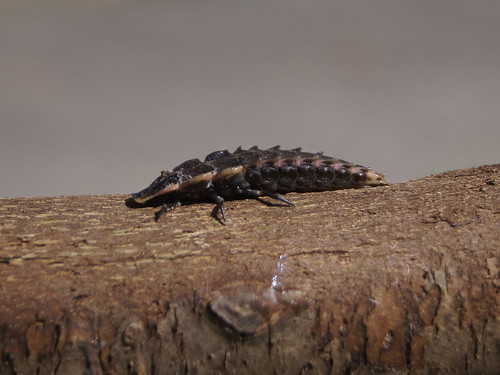
Predaceous, bioluminescent lavrvae lurk beneath the yellow-flowered dogwood, magnificent magnolias and narcissus multitudes on the first day of Spring.   Lamprydiae thrive at the Morris Arboretum.  You have seen them as adults, nocturnal summer fliers - the fireflies.  
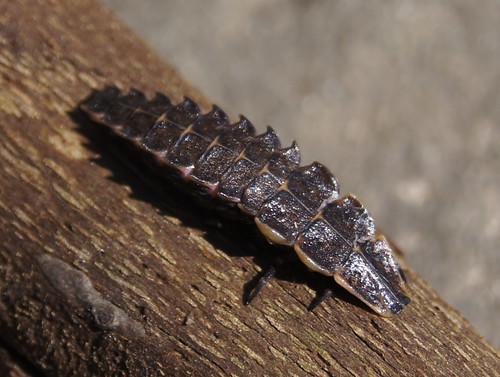
  

I found this creature under a large hemlock (Tsuga canadense) in the collection.  It measured nearly one inch, had six legs and eleven segments.  I sent pictures to my "go to" source for insect ID http://www.bugguide.net/. A quick reponse told me it is an unidentified firefly (Lampridae) larvae.
About three dozen firefly species occur in Pennsylvania, with at least a few here at the Morris Arboretum. Perhaps this is the larvae of the state insect of Pennsylvania, Photuris pennsylvanica


I found lots of good Firefly information on Wikipedia:

... Fireflies hibernate over winter during the larval stage, some species for several years. Some do this by burrowing underground, while others find places on or under the bark of trees. They emerge in the spring. After several weeks of feeding, they pupate for 1 to 2.5 weeks and emerge as adults. The larvae of most species are specialized predators and feed on other larvae, terrestrial snails, and slugs. One such species is Alecton discoidalis which is found in Cuba. Some are so specialized that they have grooved mandibles that deliver digestive fluids directly to their prey. Adult diet varies. Some are predatory, while others feed on plant pollen or nectar.

... Female Photuris fireflies are known for mimicking the mating flashes of other "lightning bugs" for the sole purpose of predation. Target males are attracted to what appears to be a suitable mate, and are then eaten. For this reason the Photuris species are sometimes referred to as "femme fatale fireflies."

Wednesday, March 16, 2011

Extending Arboriculture to the Public

Yesterday, Bryan Thompson-Nowak, the Walter W. Root Endowed Arborist intern, presented his project, entitled “Extending Arboriculture to the Public".


Arborists commonly capture the attention of those passing by when they are performing their maintenance duties high in trees. People will stop and watch what the arborists are doing and often have many questions. Bryan's project aims to take capitalize on these sorts of regularly occurring "teachable moments" through an informational sandwich board that can easily travel to different sites with the arborists.  The information is layed out in an easy to understand manner with graphics to help explain the work going on without distracting the arborists in the trees..see images below.


One side of the panel graphically explains how an arborist climbs a tree, identifies the equipment being used and has a rope with a climbing "friction hitch" knot and carabiner attached for hands-on learning.

The opposite side has a top portion made with dry-erase board film that can be written on.  The arborists will write on this part of the panel to identify the common and scientific name of the tree that is receiving care as well as point out the type of work being done.  The bottom of the panel highlights some of the common maintenance issues that need remedied on young and mature trees.

Bryan did a great job presenting his project and putting together an informational learning panel that will take advantage of many teachable moments around the garden.  Next time you are at Morris Arboretum and see the arborists working in a tree, look for the sandwich board and learn a little more about what the arborists are doing.

Also, check out this great YouTube video showing how Bryan climbs through a tree:

Monday, March 14, 2011

Morris Arboretum Top of the List in AAA World

Morris Arboretum makes the list of Gardens in the Mid-Atlantic in AAA Magazine.  Take a look - a regional destination!

Tuesday, March 8, 2011

Low down at the Morris Arboretum

Bob Gutowski, Director of Public Programs 
March flowers can be found low down.  Hellebores, crocus, snow drops and more are poking up.  I took a walk on Saturday and got down to taking pictures.
Honey bees, Apis mellifera, were busy visiting Crocus on the slope above the Rose Garden on March 5th. I wonder if crocus honey tastes like saffron?


Snow Drops, Galanthus elwesii, are bigger flowered and have broader leaves than the more common G. nivalis. These are in the woods near Out on a Limb, March 5th.

Hellebore flowers are abundant in March throughout the Arboretum.  Look for them in shady spots.  This one on the edge of the woods by Out on a Limb caught my eye with its near-black leaves and dark, dark flowers.  The leaves will green up later.  March 5th. The little stem is Poison Ivy!  Learn to recognize this in your garden.

See more of my photos on Flickr:  http://www.flickr.com/photos/versicolor/

Monday, February 21, 2011

Witchazels in bloom

Did you know that the Arboretum has fabulous color and fragrance even in the middle of winter? With remnants of snow still on the ground it is easy to think that we have to wait until spring for flowers to start blooming to see colorful life.  But that is not true!   
During the month of February, we focus our eyes on one of the harbingers of spring: the witchazel.  Witchazels at Morris Arboretum are blooming right now throughout the garden and come in a spectrum of colors and smells.  The pictures on this post are from Bob Gutowski, our Director of Public Programs.  You can see more of his wonderful photos on his Flickr site here: http://bit.ly/dHS4ET


To help you explore the witchhazels at the Arboretum, we have created a treasure hunt map distributed at the Visitor's Center (also available online here: http://bit.ly/cLriBi). This map highlights the location of several different varieties of witchazels throughout the garden and also has space on the back to record your findings.  Grab a map and go see if you can find these witchazels in bloom - this is a fun activity for the whole family!

On Sunday, February 27, 12-2pm, grab your family and head over to the Arboretum for a day of fun and exploration. Follow the treasure hunt to discover the many varieties of witchhazels growing at the Arboretum and then stop by the Visitor Center to make a fun craft. 


Thursday, February 10, 2011

Stir crazy? Plan a walk on Morris Arboretum's paved paths for benefits to both mind and body

New York Times Science section cites mental benefits of walking, to add to its physical benefits.
Fitness: A Walk to Remember? Study Says Yes


By PAULA SPAN

Published: February 7, 2011

In healthy adults, the hippocampus — a part of the brain important to the formation of memories — begins to atrophy around 55 or 60. Now psychologists are suggesting that the hippocampus can be modestly expanded, and memory improved, by nothing more than regular walking.

In a study published on Jan. 31 in The Proceedings of the National Academy of Sciences, researchers randomly assigned 120 healthy but sedentary men and women (average age mid-60s) to one of two exercise groups. One group walked around a track three times a week, building up to 40 minutes at a stretch; the other did a variety of less aerobic exercises, including yoga and resistance training with bands.

After a year, brain scans showed that among the walkers, the hippocampus had increased in volume by about 2 percent on average; in the others, it had declined by about 1.4 percent. Since such a decline is normal in older adults, “a 2 percent increase is fairly significant,” said the lead author, Kirk Erickson, a psychologist at the University of Pittsburgh. Both groups also improved on a test of spatial memory, but the walkers improved more.

While it is hard to generalize from this study to other populations, the researchers were delighted to learn that the hippocampus might expand with exercise. “And not that much exercise,” Dr. Erickson pointed out.
People don’t even have to join a gym, he noted. They just need shoes.

Morris Arboretum offers guided Wellness Walks every Saturday morning at 10:30 AM, free with regular garden admission. Meet at the Visitors Center wearing appropriate clothing for the weather and comfortable shoes, and be prepared for a brisk walk of approximately 2 miles on the Arboretum's paved paths .

http://www.morrisarboretum.org/

Tuesday, February 8, 2011

There's a new botanist in town at Morris Arboretum

Springfield Sun writer, Nicole Jenet reports on Morris Arboretum's new botanist.


Botanist Michael Burgess joined the staff of Morris Arboretum, Chestnut Hill, Jan. 4.

Since the beginning of January, Michael Burgess has been settling in as the Morris Arboretum’s newest research botanist.

Burgess, a New Hampshire native, relocated to Chestnut Hill with his wife, Susannah Burgess, and 9-month-old daughter, Ada, for what he called a “wonderful opportunity” with the arboretum, where he would have the opportunity to work with a team of “exceptional” botanists.
In his new position, Burgess said Tuesday that he will be responsible for updating and redesigning the Pennsylvania Flora Project website as well as getting involved in field work and research and possibly assisting in teaching the arboretum’s field botany and plant systematics classes.

While acquiring his master’s from the Antioch University of New England, Burgess said he was inspired to go into botany from a professor and botanist.

“I was walking in the woods and he was pointing out a number of plants and naming them. I was awestruck by his knowledge,” he said of the field he soon became “consumed with.”

Burgess debated between going to law school or working for his Ph.D. He said he had a strong passion to teach on the college level, and he needed a Ph.D. for that.
“I was weighing those two options, and I landed on the side of science,” he said.
So he studied plant systematics.
He received his doctorate from the University of Maine, where he completed his dissertation research on the genus Amelanchier — also known as the serviceberry.

“I’ve always been attached to the outdoors, and I guess it was just a natural outgrowth from that,” Burgess said.

At the arboretum, Burgess will be able to focus on things he can continue to expand upon and develop a different skill set and continue to enhance it as a field botanist, he said.

“I tend to just love the idea of being outside,” Burgess said of being a field botanist, rather than a botanist who works in a lab.
In four years of graduate school, Burgess said, you “lose touch with the world because you’re so focused on your work,” but “everyone has been very warm and genuine, opening up their culture and welcoming” him at the arboretum.

“Everyone here is generally interested not just with what they do, but where they are,” Burgess said of his co-workers, who, he said, tend to have more of a “family feel, not just a work culture.”
For more information about Morris Arboretum's botany research, Botanical Research at Morris Arboretum